American Revolution Turning Points - The Battle of Trenton
The Battle of Trenton was a Christmas present of the best kind for the Continental Army of George Washington

The Battle of Trenton, fought in December of 1776, is another famous battle of the Revolutionary War. Aiding in its popularity is the massive 1851 painting by Emanuel Leutze of Washington crossing the Delaware River. I find Trenton important for two reasons, one of which is instructive and the other probably ridiculous, except maybe to me and a few older Los Angelenos. Bear with me on this one . . .
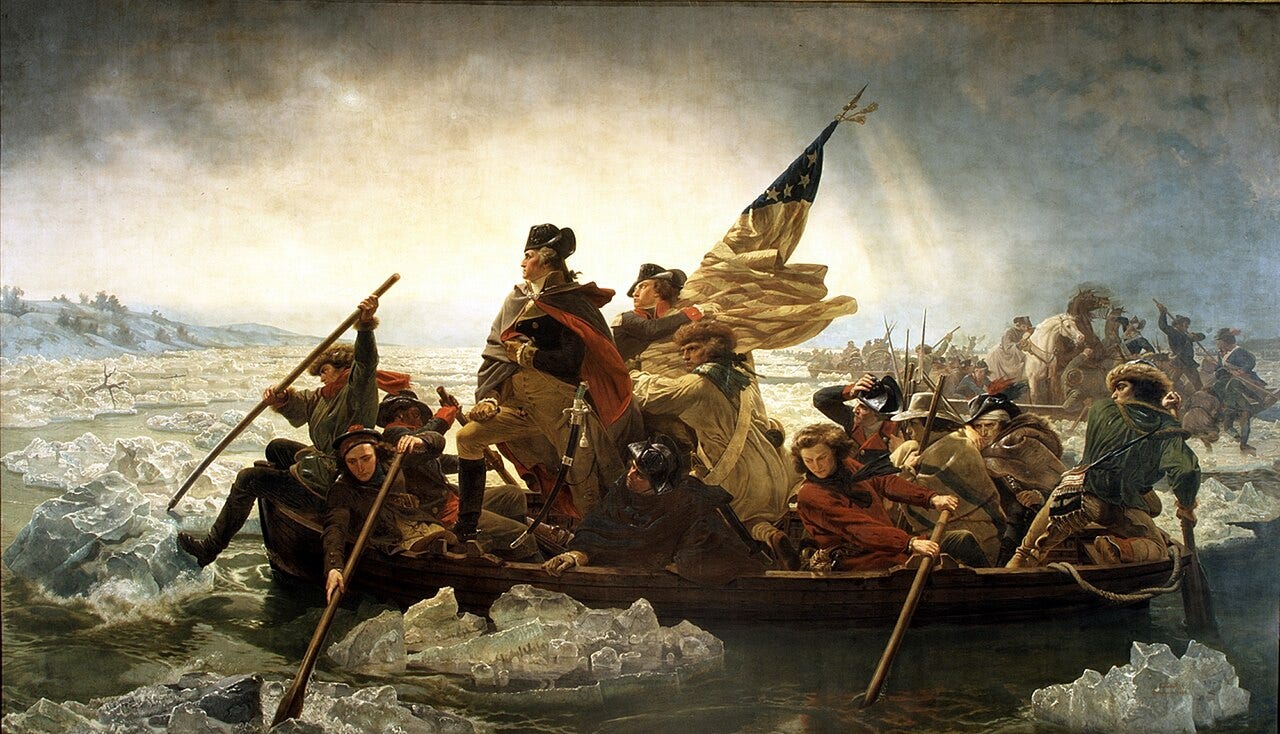
The lead-up to this battle is rather familiar, I think. Following the loss of New York (yesterday’s article—read about it here) and some other battles that failed to produce any clear victories, George Washington’s army was in sorry shape as 1776 drew to a close. Many of his men had enlisted through the end of the year, and as that end approached, Washington needed something to restore morale and get the men to reenlist. Without that, he’d have no army to continue the war.
Washington’s resolution to this quandary was a surprise attack on British and German mercenary forces stationed in Trenton, New Jersey, on Christmas night. Taken completely off-guard, the defenders suffered severe casualties and lost many valuable supplies to the Americans. This, along with success at the Battle of Princeton, was a major win for Washington and helped rebuild the confidence of his men. Many would indeed reenlist, giving Washington the soldiers needed to stay in the field and continue the war.
Was Washington lucky at Trenton, or good? This time: Mostly good, although a little lucky that the opponents took so little preparation against the possibility of attack.
Now, on the Los Angeles thing. Call me nuts, and maybe you’re right, but this battle had a major impact on the future in another way. I’ve read that the great baseball pitcher Orel Hershiser traces his ancestry to Hessian mercenaries brought (or maybe bought is the word?) by the British to fight in the Revolutionary War. A few of those Hessians survived the Battle of Trenton, one of them eventually siring children and producing a family line leading to a tremendous right-handed pitcher who starred for the Los Angeles Dodgers in their 1988 World Series win over Oakland.
So, for those older readers who, like me, watched that World Series hoping against hope for the underdog Dodgers to pull the upset over mighty Oakland (the As had 104 wins during the regular season), tip your ballcap to the Hessian mercenary lucky enough to dodge some bullets and make it through the battle. Hershiser threw two complete games in that World Series, winning both and allowing but two runs while striking out seventeen Athletics in the process. Los Angeles owes a debt of gratitude to the survivors of this battle on the enemy side.
We have a couple Revolutionary War battles still to go. After that, I plan to bring up topics that are not beholden to chronology. But it seemed like we should start our series on key events in American history with the two things that got the United States going in the first place—the Declaration of Independence and the Revolutionary War.
If you have events you want to know more about, I take requests from paid subscribers.
Author’s Note: I do not use any AI when writing my Substack pieces.