The Boston Tea Party - What You Didn't Learn in School
Everyone agrees it contributed to the American Revolution, but . . .

I’ve done some reading about the Boston Tea Party lately and learned a few things I think my readers will find interesting. If you can remember all the way back to high school history and what you learned about the Boston Tea Party, the story probably goes something like this.
In 1773 the British Parliament passed the Tea Act. Britain’s North American colonists, outraged that Parliament had taxed them without representation, retaliated. A band of patriots disguised as Native Americans boarded the ships in Boston’s harbor one night. After throwing chests of tea overboard, they dispersed. This event outraged the British government. It responded with harsh measures known as the Coercive Acts, making the American Revolution more likely.
If this is what you learned, it isn’t wrong, exactly, just incomplete. And what you didn’t learn is at least as interesting and informative as what you did learn.
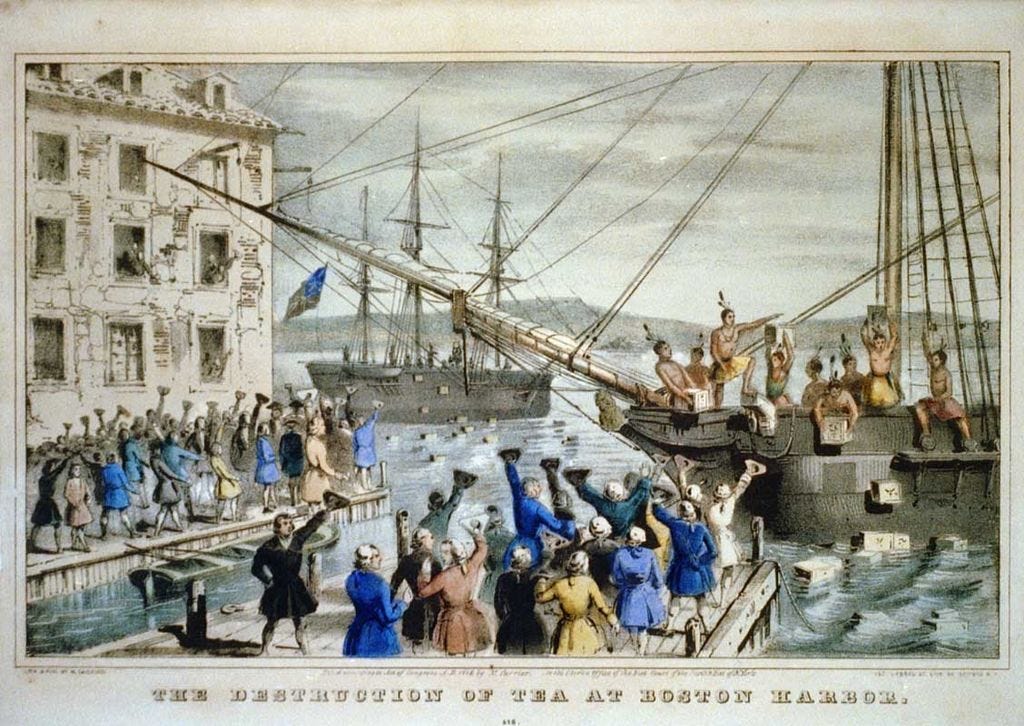
A Currier and Ives lithograph of the Boston Tea Party.
The Tea Act & the Boston Tea Party
First, let’s recall why Britain passed the Tea Act in the first place. The British East India Company (EIC) was in some trouble, financially speaking. To bail it out, Parliament passed the Tea Act in May of 1773. This act allowed the EIC a monopoly on shipments of tea to Britain’s North American possessions. It also allowed the EIC to bypass the tax normally charged on these shipments by the British government, allowing it to undersell all competitors. The shipments traveled on EIC ships.
These things were quite important. It meant that American merchants who took part in the tea trade couldn’t compete, and the ships they owned couldn’t carry the tea, either. So, colonial merchants couldn’t make money from trading tea or from transporting it. This opened the door for an unusual alliance.
The group that led the opposition to the British in Boston was the Sons of Liberty. Samuel Adams (cousin of the future president) and John Hancock led the Sons of Liberty. They burst onto the historical scene in 1765 by spearheading colonial resistance to the Stamp Act and had remained thorns in the side of the British ever since.
Now comes the best part. Both Sam Adams and John Hancock were also tea smugglers. They’d been evading British customs and smuggling tea through Dutch merchants prior to the Tea Act, but the Tea Act would shut them down if enforced.
The Alliance that Produced the Boston Tea Party
So, Adams and Hancock decided the Tea Act must not be enforced. Other merchants in Boston, their livelihoods now in danger, were willing to cooperate. Normally, they steered clear of the Sons of Liberty. Prevailing economic theories of the day held that only importing and exporting increased wealth; interior trade (trade within a colony) only rearranged it. So, Boston’s merchants had no desire to anger the British when they believed trade with Britain the only true source of wealth. But with that trade threatened by the EIC’s monopoly under the Tea Act, this time, they were willing to go along with the Sons of Liberty.
What happened next is well known. On December 16 of 1773, the Sons of Liberty led Bostonians onto three British ships and dumped about 45 tons of tea into Boston’s harbor. They concealed their identities, many never admitting their involvement even after the fact. The British responded with the Coercive Acts of 1774, and Lexington and Concord followed the next year.
But here we have a convincing explanation for the destruction resulting from the Boston Tea Party. Dumping the tea wasn’t necessary, strictly speaking. A boycott of EIC-transported tea was certainly an option. The American colonists had used the boycott against the Townsend Duties in 1767, causing British trade to fall off by about 40% and causing Parliament to repeal all the Townsend Duties but one by 1770. Why not use the boycott again?
A boycott wouldn’t have changed the EIC’s monopoly. The tea that tea smugglers depended upon still couldn’t reach Boston if the colonial governor remained intent on enforcing the Tea Act, which royal governor Thomas Hutchinson had determined to do. So, rallying the masses for a more dramatic action made sense.
An Echo?
Although it seems no one can say so too loudly because of patriotism and the assumed sanctity of anything regarding the American Revolution, there are lessons here. For one, economic motives matter. An enormous part of the American Revolution was economic in nature—remember all those taxes? Only later, after the Declaration of Independence and a few pamphlets authored by Thomas Paine, did the American Revolution begin to take on its greater meaning as a revolution to establish liberty as a national principle.
It seems heresy, however, to suggest that Founding Fathers like Hancock and Adams acted primarily from such crass motives as profit, and illegal profit, at that. For many of us, the motives of the founding generation must be pure and sacred. Among other things, this belief provides a national Garden of Eden where the country would be perfect again, if only it could return to what it was at first. What damage does it do, then, to our national longing for original innocence to know that the flaws of greed and manipulation were there from the beginning?
Speaking of manipulation, that is another lesson present here. The skill of elites in manipulating the masses for their own economic benefit through appeals to patriotism and anger rarely fails. The tactic works so well, in fact, that it has remained a staple of political manipulation to the present day.
This works even better when combined with the next lesson, which is to give that manipulation the façade of democracy. (The Sons of Liberty held a vote on what to do the morning of the Tea Party, for instance.) This helps turn regular people into willing participants, even when the democratic choices fall within a narrow range of options prescribed by the elites, and it isn’t immediately clear how regular people will benefit from joining causes with the elites. It also helps when the focus of people’s anger appears clear-cut—in this case, the tyrannical British. Making the “democratic” choice a choice between good and evil, black and white, right and wrong—this sweeps up all but the most self-aware and skeptical.
So, then, we have a Boston Tea Party held for the benefit of colonial smugglers. The consequences went beyond what Sam Adams and John Hancock expected, perhaps, but they had their eyes on their bottom lines all along.