Breaking Treaties - What Started this American Tradition?
The practice of breaking treaties and agreements when convenient has a long history in the United States.

Sad to say, one of the most enduring traditions of American political history is breaking agreements when convenient. The country has been doing so from its earliest years. Depending on your background, you may find this statement surprising. Many Americans believe their government is honorable and its treaties sacred, or, at least, that at some point in the past the country was more honorable than at present. (Finding things sacred isn’t something that secular governments are supposed to do, but you get the idea.)
I think this belief partly explains why many people look backward to the founding generation for inspiration. If they were perfect, and the present is not, then the answer is to return to where we started, to find our way back to our national Garden of Eden, if you will. So, we want to assume that in the past the United States government behaved better than it does at present.
To clarify why I find this viewpoint inaccurate, I’d like to lead with one of the most ridiculous and dishonest statements to ever enter an act of the United States government. Consider the following passage from Section 14, Article 3 of the Northwest Ordinance of 1787:
“The utmost good faith shall always be observed towards the Indians; their lands and property shall never be taken from them without their consent; and, in their property, rights, and liberty, they shall never be invaded or disturbed, unless in just and lawful wars authorized by Congress; but laws founded in justice and humanity, shall from time to time be made for preventing wrongs being done to them, and for preserving peace and friendship with them.”
Whenever I read this, I’m reminded of what Luke Skywalker says to Rey in episode eight of Star Wars. When she tries to describe to him how the Force works, he replies: “Impressive. Every word in that sentence was wrong.”
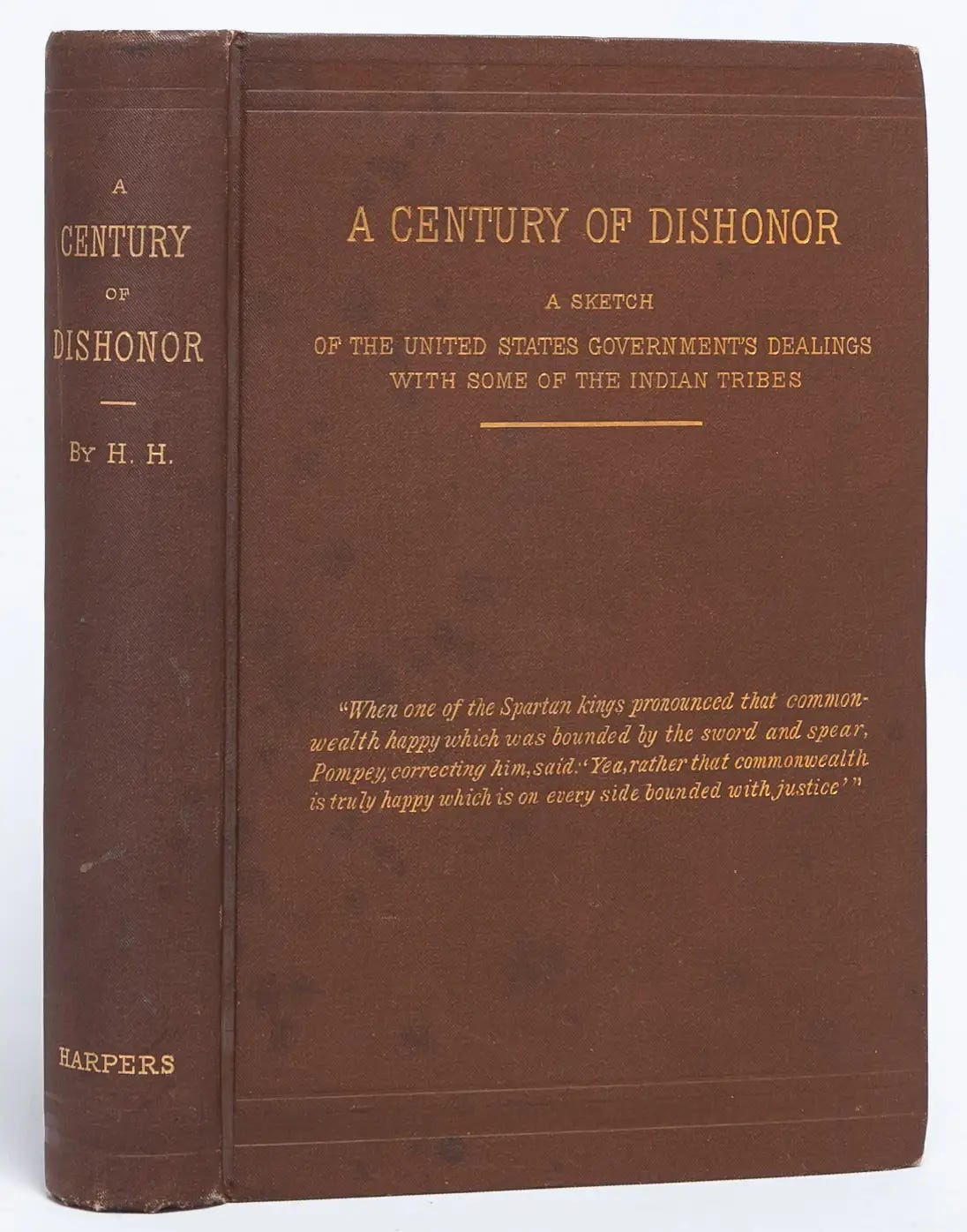
Every word in the above quote is wrong, and even in the past, some Americans acknowledged this fact. In 1881 a woman named Helen Hunt Jackson wrote the book A Century of Dishonor: A Sketch of the United States Government’s Dealings with Some of the Indian Tribes. Jackson pointed out things that are now common knowledge among students of relations between the United States and the various Native American tribes of North America. Expansion by the United States was at the root of most of the conflicts, the U. S. government had an abysmal record at keeping its treaties, and the only policy it ever developed for handling the problems created thereby was to send in the cavalry and open fire.
I always thought that the following quote, attributed to the Roman writer Tacitus, sums up the American policy toward Native Americans: “They plunder, they butcher, they ravish, and call it by the lying name of ‘empire.’ They make a desert and call it ‘peace.’”
But surely, our national record must look better when it comes to our dealings with foreign nations?
Let me tell you what happened in 1792.
Recall that France was the ally of the United States during our War of Independence. The French Navy aided our cause substantially in the Battle of Yorktown, as I wrote in my last article. Well, by 1792 France had undergone a revolution of its own, and as that revolution developed, France’s relations with other major European powers grew worse. In that year France went to war against the Austrians, Prussians, Spanish, and British, a war sometimes known as the War of the First Coalition.
Naturally enough, the French expected that the United States would come to their aid. We were allies, right?
“Not so fast,” said George Washington. “We’ll sit this one out.” (I’m paraphrasing here.)
That decision made, Washington looked about for the means to justify his choice. He and his Cabinet eventually came up with two reasons. First, the alliance had been with the old government of France, not the French nation or French people. Once France beheaded its king (January 1793) and changed its form of government, the old alliance was dead. Alexander Hamilton also claimed that the alliance with France had been a defensive alliance, and thus the Americans were not obligated to aid France when it undertook an offensive war.
I can confirm that from a military standpoint, Washington’s move was the proper one. He lacked the naval power to aid France at sea, and without that, getting any American forces to Europe safely was questionable. Entering a new war against the British would also be risky and open the possibility of battles on our home territory.
Still, we were allies with France. Friendship means showing up for your friends when their need is greatest. Instead, Washington stood down, declared neutrality, and mumbled “This is the way.” So, the alliance with France died with the U.S. waving to the French from across the Atlantic and wishing them good luck without us.
Breaking treaties and agreements when convenient, then, has been an American practice from the beginning. I don’t have time to break down all the examples here, but I’ll add a few more. When the Spanish-American War began in 1898, we offered the Cubans the Teller Amendment. By the time it was over, we’d changed our minds and gone with the Platt Amendment instead. The Boland Amendment in 1980s Nicaragua turned into the Iran-Contra Affair. In 2015 the United States signed the Joint Comprehensive Plan of Action to limit nuclear weapons development in Iran, but then backed out a few years later because of Republican racism against Barack Obama.
At present many Americans, myself included, are distressed by our government’s needless antagonism toward our allies in the North Atlantic Treaty Organization (NATO), formed in 1949. But the real wonder of the U.S. relationship with NATO, historically speaking, is that we’ve honored the alliance as long as we have. Perhaps the other members should’ve read their American history and been more prepared for our present behavior.
Thanks for reading. I welcome polite comments.
Author’s Note: I do not use any AI when writing my Substack pieces.