How Many Gorsuchs Does it Take to Destroy a Democracy?
Neil Gorsuch is a given here, but his mother, Ann Gorsuch, was the first family member to stab America in the chest.

If you follow current events to any extent, you know that Neil Gorsuch is one of the six conservative members of the United States Supreme Court. He’s done a lot of damage in just a few years on the court, placing presidents above the law for official acts, destroying deference to agency experts, issuing racist rulings, and so on. But he isn’t the first member of his family to set out to make life worse for ordinary Americans.
That dubious distinction goes to his mother, Ann Gorsuch, later Burford.
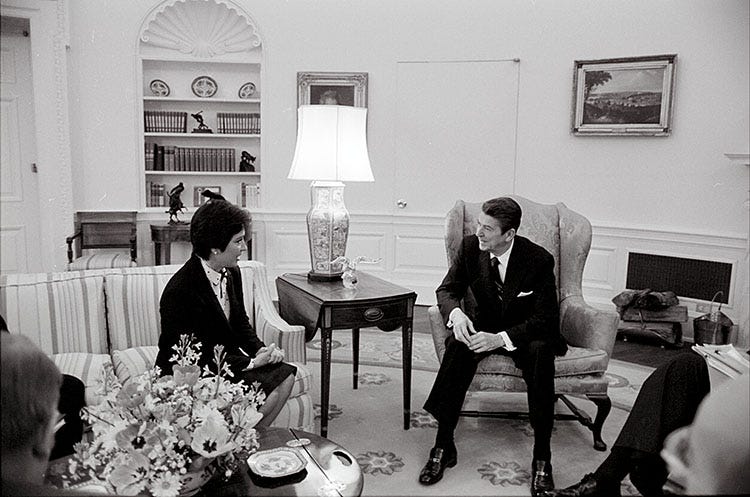
Some of you may remember this story personally. Ronald Reagan put Ann Gorsuch at the head of the Environmental Protection Agency (EPA) in 1981. If you weren’t paying attention to who she actually was, this seemed a reasonably progressive move. She was the first woman to head the EPA, and putting a woman in charge of a federal agency was less common at the time.
But today Ann Gorsuch is better known for another, more unsavory, first—the first head of a federal agency to be held in contempt of Congress. Let’s explore this story.
She got the position because of her political friendship with Interior Secretary James Watt (he of the “I Know Watt’s Wrong” bumper stickers) and Pete Coors, the Colorado beer brewer. Both were arch-conservative reactionaries who recommended Gorsuch to Reagan.
One of the tasks of the EPA is the cleanup of the nation’s toxic waste sites. The Superfund law of 1980 charged the EPA with tackling the worst abandoned toxic waste dumps within the next five years and maintaining a listing of sites to add to its cleanup list in the years to come. Simple and straightforward, in theory. Also frightening—let me hit you with some statistics here.
By 1983, the first comprehensive listing of toxic sites put 406 sites on the National Priorities List. That’s an average of eight sites per state deemed major threats to public health. These were only the most substantial threats to public health. Thousands of other sites with a lesser level of threat have been identified since 1983. Currently, 1,346 sites are on the National Priorities List. Roughly one American in seven lives within three miles of a toxic site that has not been rehabilitated in full.
Faced with this daunting task requiring immediate, decisive action, Ann Gorsuch violated hosts of laws. After two years, the EPA had begun cleanup at five sites.
By law, the EPA was required to recover the cleanup costs from the polluters responsible. But Gorsuch settled with the polluters for a fraction of the cleanup cost, absolving them of legal responsibility for further cleanup at the same time. Some of her employees took favors and money from heads of polluting industries. Another simultaneously worked for the EPA and offered legal representation to clients fighting the agency’s policies. Later documents revealed she’d been aware of the misconduct yet took no action to remedy the problem.
When confronted with such an obvious disdain for the law, Congress did what it should have done. It subpoenaed documents regarding Gorsuch’s conduct as the head of the EPA. One task of Congress is to see that its laws get carried out (although it is the Executive Branch that does the actual enforcement), and it requires documents to prove whether this is happening.
Gorsuch would not comply. President Reagan tried to give her cover, claiming she could withhold the documents because executive privilege required it. It was the flimsiest of excuses—clearly, this was not a national security issue, and the documents Congress requested were not even ones Reagan had ever looked at. One might conclude that if they were critical enough to warrant executive secrecy, the executive would have at least looked at them in the prior two years. How could Reagan know they required executive privilege if he’d not seen them?
Eventually, Gorsuch’s political support evaporated, and less than two years after taking her position, she resigned. But the reaction to her departure tells us a great deal that is relevant to her family’s odyssey and beyond.
President Reagan, never one to let facts stand in the way of the fantasies he wanted to promote, portrayed the departing Gorsuch as martyr whose career environmentalists would stop at nothing to destroy. He said Gorsuch was “a far bigger person than those who have been sniping at her with unfounded charges . . . I wonder how they manage to look at themselves in the mirror in the morning.”
Statements like this helped to lay out the blueprint that conservatives have followed ever since when confronted with environmental issues. Critique the opposition as radical environmentalists. Deny wrongdoing. Claim that opponents hold a personal vendetta against honest conservatives.
Reagan’s actions followed a second blueprint as well. He was notoriously obsessed with decreasing the number of functions performed by the U.S. government. Yet agencies like the EPA enjoyed widespread public support in the 1970s. So, he had to sabotage that public support.
Appointing people like Ann Gorsuch and James Watt proved part of the answer. If Reagan put people at the head of government agencies who were hostile to the mission of their agency, they would do their job poorly, if at all. When the public saw the agencies performing badly and getting nothing done, people would lose confidence in the integrity of the agency. Reagan could then use that as an opportunity to claim that government was the problem—its agencies were ineffective, wasteful, and the public could do without them. If one only looked at the lousy surface performance rather than the underlying causes of that pathetic performance, they might agree. Ever since, this practice of appointing heads of government agencies who would betray the mission of the agency has been a key tactic of the conservative master plan to destroy government oversight of anything they don’t like.
Then, of course, there is the fallout from Ann Gorsuch’s story that still bedevils the United States today. Her son Neil is a Supreme Court justice, and one notoriously hostile to the mission of government agencies. It might be an oversimplification to say that his hostility is because Democrats were mean to his mommy back in 1982. He’s a member of the Federalist Society, and that organization has had years to alchemize Gorsuch into one of its obedient ghouls. But it wouldn’t be totally wrong to cite his mommy issues, either.
Thanks for reading. I welcome polite comments as always.
Author’s Note: I do not use any AI when writing my Substack pieces.
If you value quality history over opinions on politics or mass-produced AI content, please share & become a paid subscriber. You’ll get several original articles each week on American history. But I need support to validate the effort required to publish consistently. Thank you!