One War, Two Americas
The GI Bill built the postwar middle class, but Jim Crow decided which veterans could enter it.

“When we assumed the Soldier, we did not lay aside the Citizen.”
—George Washington, 1775
This article began with an idea from my friend and fellow Substack historian L.C. Francis of the L.C. Francis Open Society for History & Civics, who believed the story of the GI Bill deserved a closer look. As the story developed, we began to see something larger: another piece of the long national failure to complete Reconstruction following the Civil War. Black veterans returned from defending democracy abroad only to find that the promises made to them at home could still be filtered through the institutions of segregation. We hope you find this collaboration as informative and revealing to read as it was for us to research and write.
Dear Friends,
We want to tell you a story about Sergeant Joseph H. Maddox, who returned from World War II with an injury, a medical discharge, and an acceptance letter from Harvard University. He had earned a place in a master’s program, and the newly enacted GI Bill should have covered his tuition. Instead, his local Veterans Administration office denied him the benefit because officials wanted to avoid “setting a precedent.”
As far as the Admissions Committee at Harvard was concerned, Joseph Maddox deserved a place in its classrooms in Cambridge, Massachusetts. The government’s concern was whether a Black veteran would be treated with the same respect and acknowledgment as a White veteran. Fortunately, after the National Association for the Advancement of Colored People stepped in, Maddox received federal assistance. His journey highlighted the often unseen racial barriers embedded within one of the proudest and most celebrated laws in American history.
On June 22, 1944, about a year before the war’s end, President Franklin D. Roosevelt signed the Servicemen’s Readjustment Act, better known as the GI Bill, as American forces fought their way across Europe and the Pacific. The law covered tuition and living expenses for education and vocational training, provided temporary unemployment assistance, and guaranteed loans for homes, farms, and businesses.
The FDR administration learned from the bitter and shameful treatment of World War I veterans, many of whom returned with little support and few opportunities. During the Great Depression, thousands of veterans formed the Bonus Army and marched to Washington to demand the promised compensation, only to be dispersed by federal troops. Congress created the GI Bill to prevent another generation of veterans from facing unemployment, poverty, and betrayal.
The investment was transformative for our country because nearly eight million of the sixteen million Americans who served in World War II used the law to pursue education or training. By 1947, veterans accounted for nearly half of all college admissions, and federally guaranteed mortgages helped millions of families buy homes and join the expanding middle class.
The law’s success also extends to our family histories. After high school, one father joined the Air Force, used the GI Bill to attend college, and became a high school math teacher. His brother used the home loan benefit to buy a house and invested additional savings in an auto repair business. Their children grew up with the security of a professional salary, homeownership, and parents who could send them to college without leaving them buried in student debt.
The GI Bill was designed to achieve these types of outcomes. It honored military service with actions more meaningful than parades, patriotic speeches, or “thank you for your service.” It enabled veterans to turn their years of sacrifice into educational opportunities, homeownership, and a better start for their children.
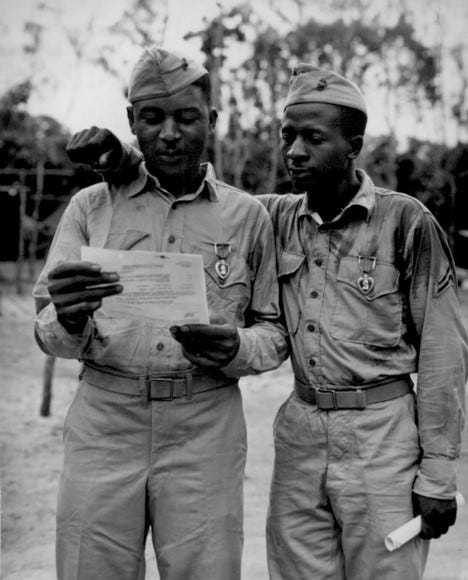
By 1945, more than one million Black Americans had also served in the war. They trained at segregated bases, served in segregated units, and fought for democracy while their families endured racial violence, segregated schools, and Jim Crow laws that kept them from voting. When those servicemen returned home, the GI Bill seemed to promise them the same opportunities.
The wording of the law did not bar Black veterans, but Congress allowed colleges, banks, employers, and state officials to decide whether the promise would be fulfilled. Universities decided who to admit, businesses chose who to train, private lenders selected which mortgage applications to approve, and local offices guided veterans through a system that often treated their race as more important than their honorable discharge.
At the center of the House negotiations stood Mississippi Congressman John Rankin, the committee chairman overseeing veterans’ legislation. Rankin openly defended white supremacy, poll taxes, segregation, and the system that kept Black citizens from exercising political power. He understood that the law did not need to include the words “white veterans only” if its benefits passed through institutions already committed to preserving the color line.
Rankin’s congressional authority stemmed from the same system. With Black citizens driven from the polls across much of the South, White politicians faced little meaningful opposition, won reelection for decades, accumulated seniority, and secured the committees that shaped national policy. Therefore, denying a Black citizen the vote in Mississippi helped a segregationist control veterans’ education, housing, and employment opportunities nationwide.
Southern leaders also had economic motives for restricting Black progress. An experienced engineer might leave the profession, and a mechanic who owned his shop no longer depended on a White employer. Families who bought farms or homes gained independence from landlords, merchants, and local authorities. Segregation preserved social norms, cheap labor, low wages, and political influence.
This is why Rankin and his political allies fought to keep the federal government from administering the GI Bill directly. Although Washington supplied the funding, state agencies, local banks, colleges, real-estate boards, and employers decided who could use it. In the segregated South, that structure left Black veterans at the mercy of the same local officials and institutions that already controlled where they could live, study, borrow, and work.
The law could therefore promise equal benefits on paper while permitting discrimination at every stage of delivery. In simple terms, Rankin didn’t rely on the GI Bill to raise the issue of race; he simply needed its benefits to be controlled by local gatekeepers who could discreetly deny access.
It’s notable that education exposed the scheme almost immediately. The GI Bill could pay a veteran’s tuition, but it could not compel a segregated state university to admit him. Most Black veterans in the South had to turn to roughly one hundred historically Black colleges and universities (HBCUs), which had done extraordinary work despite decades of deliberate neglect.
In 1945, 92 percent of these institutions enrolled fewer than a thousand students, and Southern white colleges received 92 percent of the region’s higher-education funding. No Black institution had accredited engineering or doctoral programs, and only a few offered education beyond the bachelor’s level. Most primarily trained future teachers and ministers. When thousands of returning veterans applied, the schools lacked sufficient classrooms, laboratories, dormitories, faculty, and funding to handle the surge.
An estimated 20,000 Black veterans could not enroll because these segregated colleges had no room. A survey of 21 Southern Black institutions found that 55 percent of veteran applicants were rejected due to a lack of space. These men had the ambition, the federal benefit, and the honorable discharge, yet segregation ensured the country never built enough places for them to study.
Veterans who looked north encountered distance, housing shortages, racial admission quotas, and admissions standards that were difficult to meet because of the unequal schools they had attended since childhood. Some desperate men lost their benefits to fraudulent vocational schools that sprang up overnight, collected federal funds, and offered little in the way of training.
Job programs produced similar outcomes because a veteran first needed an employer willing to provide training. In March 1946, only six of Atlanta’s 246 approved on-the-job training programs included Black veterans. Across twelve Southern states, Black men made up roughly one-third of the veteran population but accounted for only 7,700 of more than 102,000 training placements.
During the war, many men repaired aircraft, maintained military vehicles, operated heavy machinery, managed supplies, or built military installations. Yet upon returning home, employers and local counselors often steered them into menial jobs, such as washing dishes or sweeping floors, that ignored their skills and experience. The nation had entrusted these men with weapons and machinery abroad, yet at home, segregationists deemed them unfit for skilled work.
Housing discrimination inflicted a profound wound, and its effects were passed down through generations. Although the federal government guaranteed a portion of a veteran’s mortgage, the final lending decision rested with private banks. Black applicants also faced redlining, restrictive covenants, unwelcoming real estate agents, biased appraisals, and suburban neighborhoods that explicitly excluded their families.
The figures were shocking. In 1947, the Veterans Administration guaranteed 3,229 home loans in thirteen Mississippi cities, yet only two went to Black veterans. Northern states offered little help. In New York City and the northern New Jersey suburbs, for example, nonwhite borrowers received fewer than 100 of about 67,000 GI Bill mortgages. Black veterans were eager to buy homes and start new lives after the war, but banks nationwide kept turning them away.
A rejected mortgage meant far more than the loss of a single house. White veterans made monthly payments on properties that generally appreciated in value. They borrowed against their equity to open businesses, pay their children’s college tuition, weather periods of unemployment, and ultimately pass their homes or their proceeds to the next generation.
Black veterans frequently paid rent for decades without accumulating property to leverage or pass down. Although both families worked hard and consistently paid for housing, the government-supported system enabled one family to build an asset, while the other family only generated wealth for a landlord.
The advantages flowed consistently among White families: education led to better jobs, higher salaries enabled homeownership and built equity, and that security allowed children to start adulthood without overwhelming debt. Conversely, Black families faced setbacks because the unattainable degree yielded no higher salary, and being denied a mortgage meant no inheritance, further widening the disparity.
A major 2026 economic study tracked those veterans and their sons across generations. The researchers found that GI Bill eligibility roughly doubled four-year college completion rates among White veterans, whereas Black veterans were more likely to enter vocational programs that yielded little to no improvement in earnings. These unequal outcomes widened the Black-White college gap among their sons by 47 percent.
The GI Bill deserves recognition as one of the most successful public investments in American history. It helped educate millions, expanded homeownership, strengthened the economy, and changed the course of families like ours. The injustice was not that White veterans received too much. It was the government’s decision to let race determine whether Black veterans would receive the full value of what they had earned.
Congress still has a chance to address part of this injustice. In 2025, lawmakers reintroduced the Sgt. Isaac Woodard, Jr. and Sgt. Joseph H. Maddox GI Bill Restoration Act. The bill aims to extend education and housing benefits to surviving spouses and eligible descendants of Black WWII veterans who were previously denied equal access to the original GI Bill. It remains in committee.
No law can recreate the businesses banks refused to finance, award the degrees veterans never received, or restore eighty years of lost home equity. Yet the passage of time does not erase a debt simply because the people who were cheated have grown old and died. Their descendants are not asking for charity; they are asking the United States to deliver a benefit their fathers and grandfathers already purchased through their military service.
Black veterans traveled across oceans to help defeat a racist, fascist dictatorship abroad, only to return to a government that entrusted their future to Jim Crow laws. They donned the same uniform, faced the same enemy, and made the same sacrifices, yet America offered them two vastly different welcomes.
The debt still belongs to us, and the country has patiently waited long enough for it to be settled.
Vivat Constitution!
If you value thorough, quality history over opinions on politics, memes, or mass-produced AI content, please share & become a subscriber. You’ll get several original articles each week on American history. But I need support to validate the effort required to publish consistently. Thank you!
Author’s Note: I do not use any AI when writing my Substack pieces.