Was David Walker America’s Original Abolitionist?
David Walker is not a familiar figure today. But he was among the first to dedicate their lives to ending the horrors of slavery in the United States.

David Walker, author of the publication Walker’s Appeal, is one of the greatest civil rights figures from early American history. However, it’s quite likely you’ve never heard of David Walker. Today we explore his story.
David Walker was a free African American who was born in 1796. He was from North Carolina, the son of a free mother and an enslaved father. By the 1820s he had moved to Boston and owned a clothing store. From there, he contributed to one of the first known African-American newspapers in the country, Freedom’s Journal, published in New York City.
By the 1820s Walker had gained a name as one of the nation’s bitterest opponents of slavery. From his home in Boston, he published angry appeals to the people of the United States over the injustice of slavery. The pamphlet known as Walker’s Appeal is the most famous of these.
Why Haven’t I Heard of David Walker?
In most traditional histories, the story of the abolitionist movement starts later than David Walker’s career. Typically, history books take up that story in the 1830s with figures like William Lloyd Garrison or Frederick Douglass and organizations like the American Anti-Slavery Society and the Liberty Party. But those groups had to build on the work of someone, and David Walker was one of those foundational figures.
To be honest, I’m not sure if there is any racism involved here. Walker was an African American, but other than Frederick Douglass, it’s usually White people who feature in the story of how the abolitionist movement got rolling. Is his omission part of an effort to make White Americans feel less guilty about slavery by reassuring them that they’re also the ones who took the lead on getting rid of it?
Maybe. It’s hard to say. But here at Rob’s History Notes, I’m all about trying to expand your horizons and your knowledge about history, so we’ll continue on with Walker’s story and let you learn more about this important American.
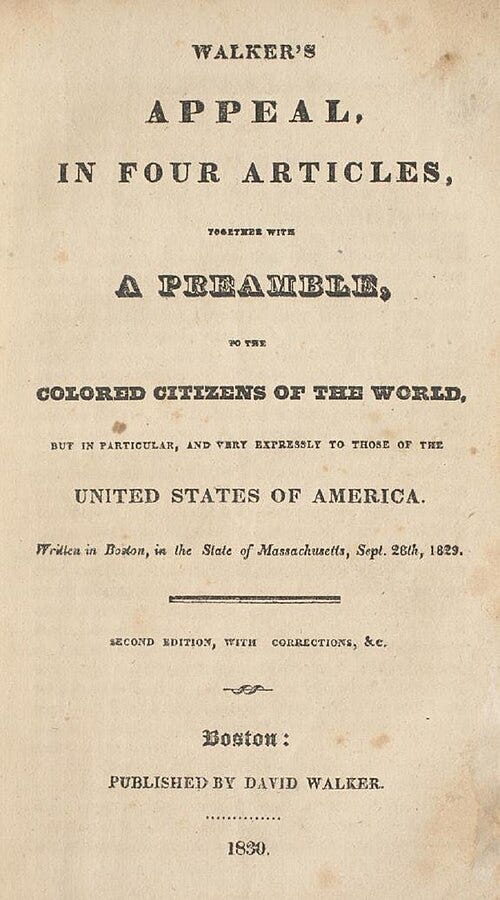
Reaction to David Walker
If the United States had a hotbed of abolitionist ideas in the 1820s and 1830s, it was probably Boston. That city was home to many of the nation’s prominent abolitionist figures who emerged at this time, like Walker and William Lloyd Garrison. From Boston, Walker disseminated his publication throughout the nation. He even had African American sailors smuggle copies of his pamphlet to the South through Boston’s port.
The content of Walker’s Appeal was incendiary. Walker urged slaves to rise up. He condemned both gradual emancipation and compensated emancipation. Likewise, he dismissed the idea of colonizing slaves to Africa, pointing out that they’d worked much harder to build the United States than those who’d enslaved them. Walker wrote in language familiar to any literate American of that era, speaking of equality, the Declaration of Independence, and all the other political rhetoric of the American Revolution. He then shoved these ideas in the face of White Americans as a mark of their hypocrisy. If they’d held a revolution featuring the belief that all are created equal, how could they justify the continuation of slavery?
This style earned Walker the undying hatred of Southerners. Modest as the circulation of Walker’s ideas were in the South, anything was too much for slaveholders to stomach. So, they put a bounty on Walker’s life—$3,000 for his head, $10,000 for bringing him alive to the South. (Averaging from some inflation calculators I looked up online, $10,000 in 1820 would be about $250,000 today.) That was the price some Americans offered for Walker’s kidnapping or assassination. In turn, this reveals how little fear White Americans in the South felt about advertising for the murder of an African American who self-evidently possessed the rights to life, liberty, and the pursuit of happiness.
Friends told him to leave the country. After all, Walker had a bounty on his head. But Walker declined. He’s reported to have said, “Somebody must die in this cause. . . . I may be doomed to the stake and the fire, or to the scaffold tree, but it is not in me to falter if I can promote the work of emancipation.”
Next time, we’ll learn what happens to David Walker, the courageous abolitionist of early America. How long will he last with an enormous bounty on his head? How did Americans 200 years ago react to someone so outspoken against slavery?
Here’s my question for you – How does learning about David Walker change your views of American history? How does our history look different with his story and without it?
If you enjoyed this content and want to see more, please subscribe. By all means, share this post online if you think others will want to hear David Walker’s story.
Thank you for reading, my friend.
Author’s Note: I do not use any AI when writing my Substack pieces.
If you value thorough, quality history over opinions on politics, memes, or mass-produced AI content, please share & become a subscriber. You’ll get several original articles each week on American history. But I need support to validate the effort required to publish consistently. Thank you!
Why haven't I heard of David Walker or his writings? Was it because he actually held a mirror up to American society of their hypocritical actions regarding the ideals of the Declaration of Independence and nobody liked hearing the truth--like today? Maybe it was a question of timing; his writing was incendiary but perhaps was on a slow fuse, burning in other minds for a time until either they reworded his ideas into their own, or someone like Frederick Douglass came along and expounded on Walker's Appeal from the perspective of a former slave. I am interested in reading about what happened in your next installment.
Unfortunately, I can.